Free download · AQA A-level Chemistry
The Organic Synthesis Map
The functional-group conversions of the AQA course, with their reagents, conditions and mechanism, drawn as linked structures. Then six synthesis routes to plan, with answers.
15 pages · 4:5 portrait, 1080 × 1350 · free to save, print and share
01 The Organic Synthesis Map02 Reading the map03 The whole map04 The halogenoalkane hub05 Adding across C=C06 Making and oxidising alcohols07 The carbonyl group08 Acids, esters and fats09 Acylation10 Nitrogen in, nitrogen on11 Keeping the ring12 Addition and condensation polymers13 Route practice14 Route answers15 Now practise it
The Organic Synthesis Map
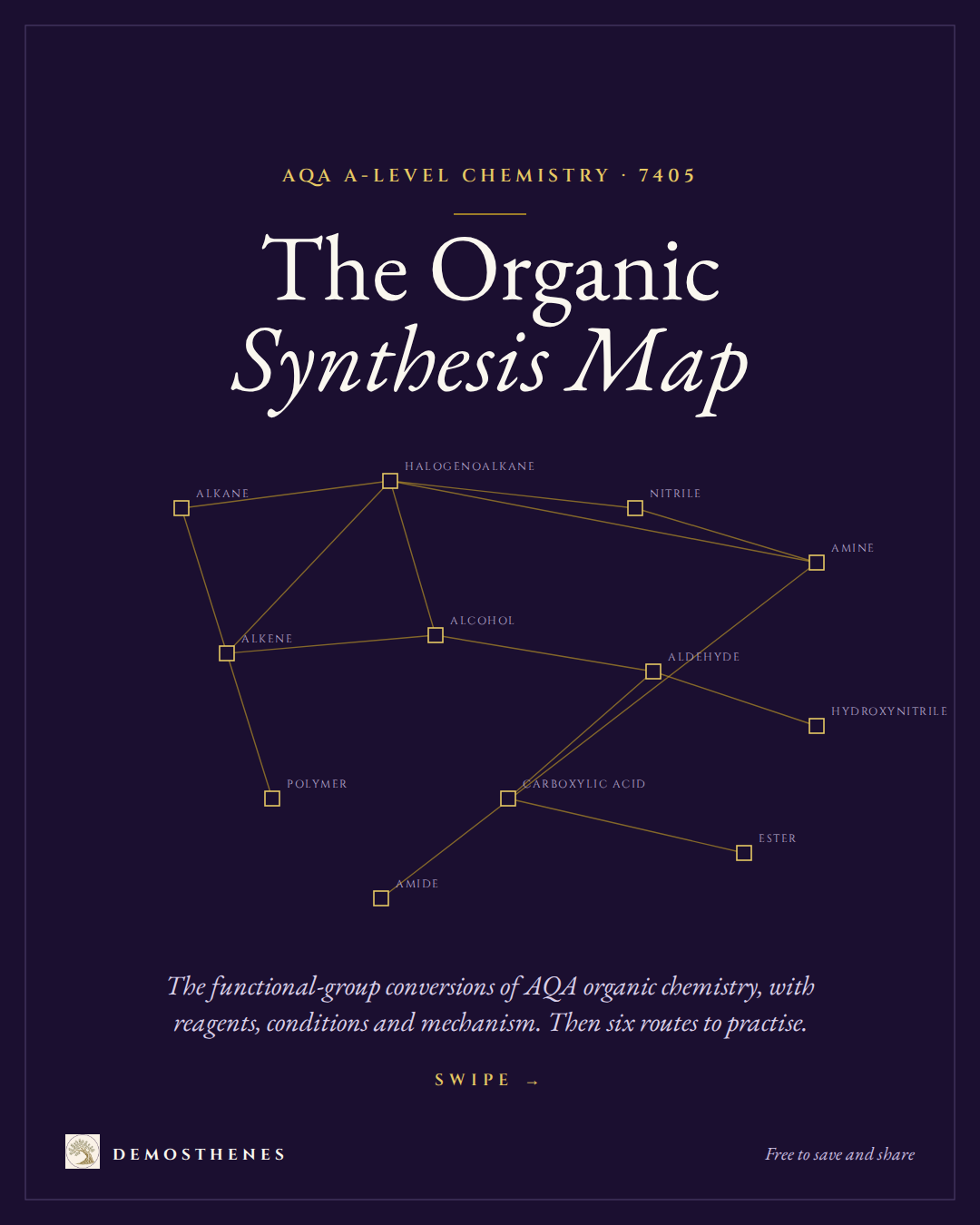
Cover: AQA A-level Chemistry 7405. The functional-group conversions with reagents, conditions and mechanism, then six routes to practise.
AQA A-LEVEL CHEMISTRY · 7405 The Organic Synthesis Map ALKANE HALOGENOALKANE NITRILE AMINE ALKENE ALCOHOL ALDEHYDE HYDROXYNITRILE POLYMER CARBOXYLIC ACID ESTER AMIDE The functional-group conversions of AQA organic chemistry, with reagents, conditions and mechanism. Then six routes to practise. SWIPE → DEMOSTHENES Free to save and share
01 The Organic Synthesis MapPNG
Reading the map
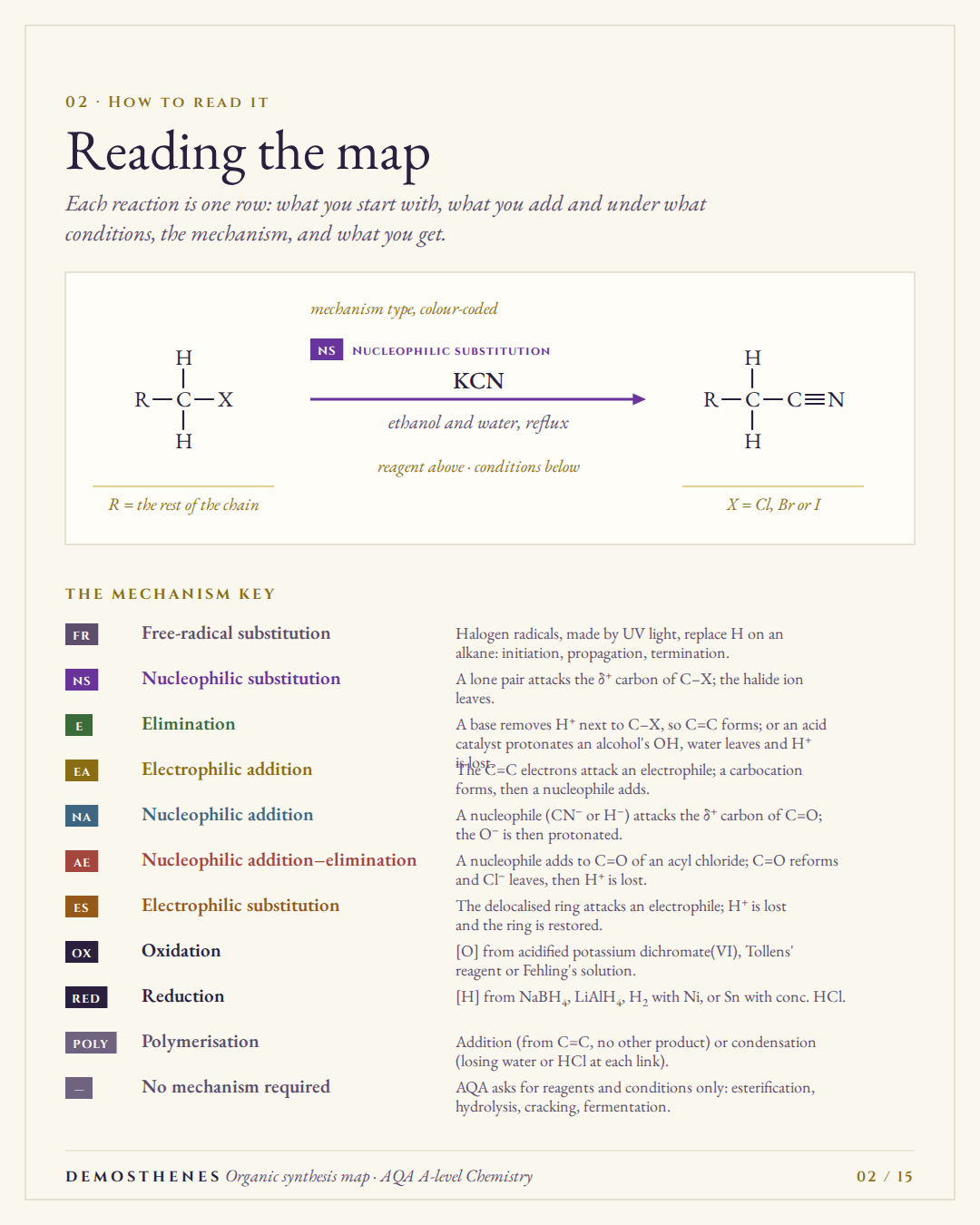
How each row is laid out, and the mechanism key: free-radical substitution, nucleophilic substitution, elimination, electrophilic addition, nucleophilic addition, nucleophilic addition–elimination, electrophilic substitution, oxidation, reduction, polymerisation, and reactions with no mechanism required.
02 · How to read it Reading the map Each reaction is one row: what you start with, what you add and under what conditions, the mechanism, and what you get. C R X H H R C H H C N NS Nucleophilic substitution KCN ethanol and water, reflux mechanism type, colour-coded reagent above · conditions below R = the rest of the chain X = Cl, Br or I THE MECHANISM KEY FR Free-radical substitution Halogen radicals, made by UV light, replace H on an alkane: initiation, propagation, termination. NS Nucleophilic substitution A lone pair attacks the δ + carbon of C–X; the halide ion leaves. E Elimination A base removes H + next to C–X, so C=C forms; or an acid catalyst protonates an alcohol's OH, water leaves and H + is lost. EA Electrophilic addition The C=C electrons attack an electrophile; a carbocation forms, then a nucleophile adds. NA Nucleophilic addition A nucleophile (CN − or H − ) attacks the δ + carbon of C=O; the O − is then protonated. AE Nucleophilic addition–elimination A nucleophile adds to C=O of an acyl chloride; C=O reforms and Cl − leaves, then H + is lost. ES Electrophilic substitution The delocalised ring attacks an electrophile; H + is lost and the ring is restored. OX Oxidation [O] from acidified potassium dichromate(VI), Tollens' reagent or Fehling's solution. RED Reduction [H] from NaBH 4 , LiAlH 4 , H 2 with Ni, or Sn with conc. HCl. POLY Polymerisation Addition (from C=C, no other product) or condensation (losing water or HCl at each link). — No mechanism required AQA asks for reagents and conditions only: esterification, hydrolysis, cracking, fermentation. DEMOSTHENES Organic synthesis map · AQA A-level Chemistry 02 / 15
02 Reading the mapPNG
The whole map
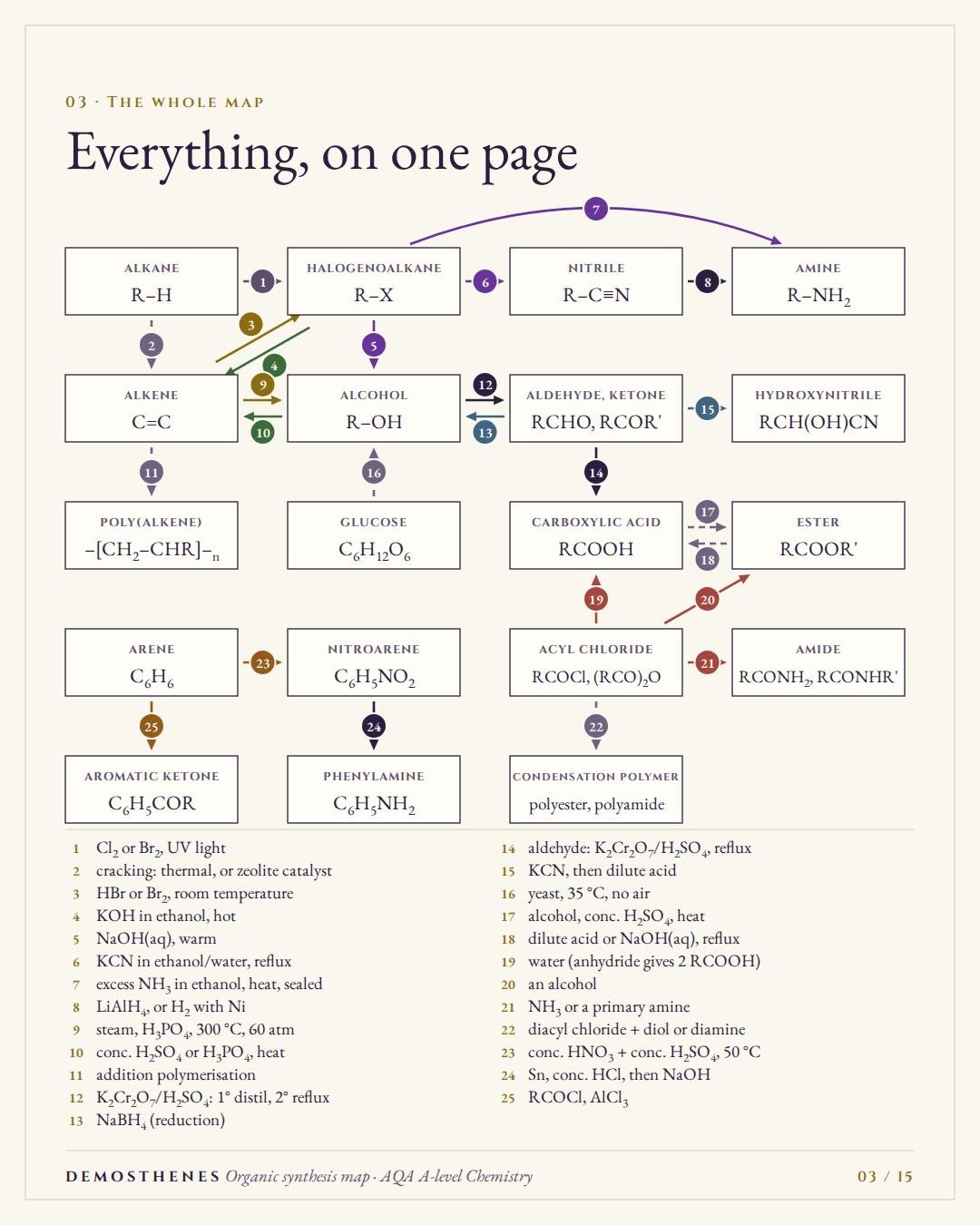
All 25 conversions as a network of functional groups, numbered, with a key giving each reagent and condition.
03 · The whole map Everything, on one page ALKANE R–H HALOGENOALKANE R–X NITRILE R–C≡N AMINE R–NH 2 ALKENE C=C ALCOHOL R–OH ALDEHYDE, KETONE RCHO, RCOR' HYDROXYNITRILE RCH(OH)CN POLY(ALKENE) –[CH 2 –CHR]– n GLUCOSE C 6 H 12 O 6 CARBOXYLIC ACID RCOOH ESTER RCOOR' ARENE C 6 H 6 NITROARENE C 6 H 5 NO 2 ACYL CHLORIDE RCOCl, (RCO) 2 O AMIDE RCONH 2 , RCONHR' AROMATIC KETONE C 6 H 5 COR PHENYLAMINE C 6 H 5 NH 2 CONDENSATION POLYMER polyester, polyamide 1 2 3 4 5 6 7 8 9 10 11 12 13 14 15 16 17 18 19 20 21 22 23 24 25 1 Cl 2 or Br 2 , UV light 2 cracking: thermal, or zeolite catalyst 3 HBr or Br 2 , room temperature 4 KOH in ethanol, hot 5 NaOH(aq), warm 6 KCN in ethanol/water, reflux 7 excess NH 3 in ethanol, heat, sealed 8 LiAlH 4 , or H 2 with Ni 9 steam, H 3 PO 4 , 300 °C, 60 atm 10 conc. H 2 SO 4 or H 3 PO 4 , heat 11 addition polymerisation 12 K 2 Cr 2 O 7 /H 2 SO 4 : 1° distil, 2° reflux 13 NaBH 4 (reduction) 14 aldehyde: K 2 Cr 2 O 7 /H 2 SO 4 , reflux 15 KCN, then dilute acid 16 yeast, 35 °C, no air 17 alcohol, conc. H 2 SO 4 , heat 18 dilute acid or NaOH(aq), reflux 19 water (anhydride gives 2 RCOOH) 20 an alcohol 21 NH 3 or a primary amine 22 diacyl chloride + diol or diamine 23 conc. HNO 3 + conc. H 2 SO 4 , 50 °C 24 Sn, conc. HCl, then NaOH 25 RCOCl, AlCl 3 DEMOSTHENES Organic synthesis map · AQA A-level Chemistry 03 / 15
03 The whole mapPNG
The halogenoalkane hub
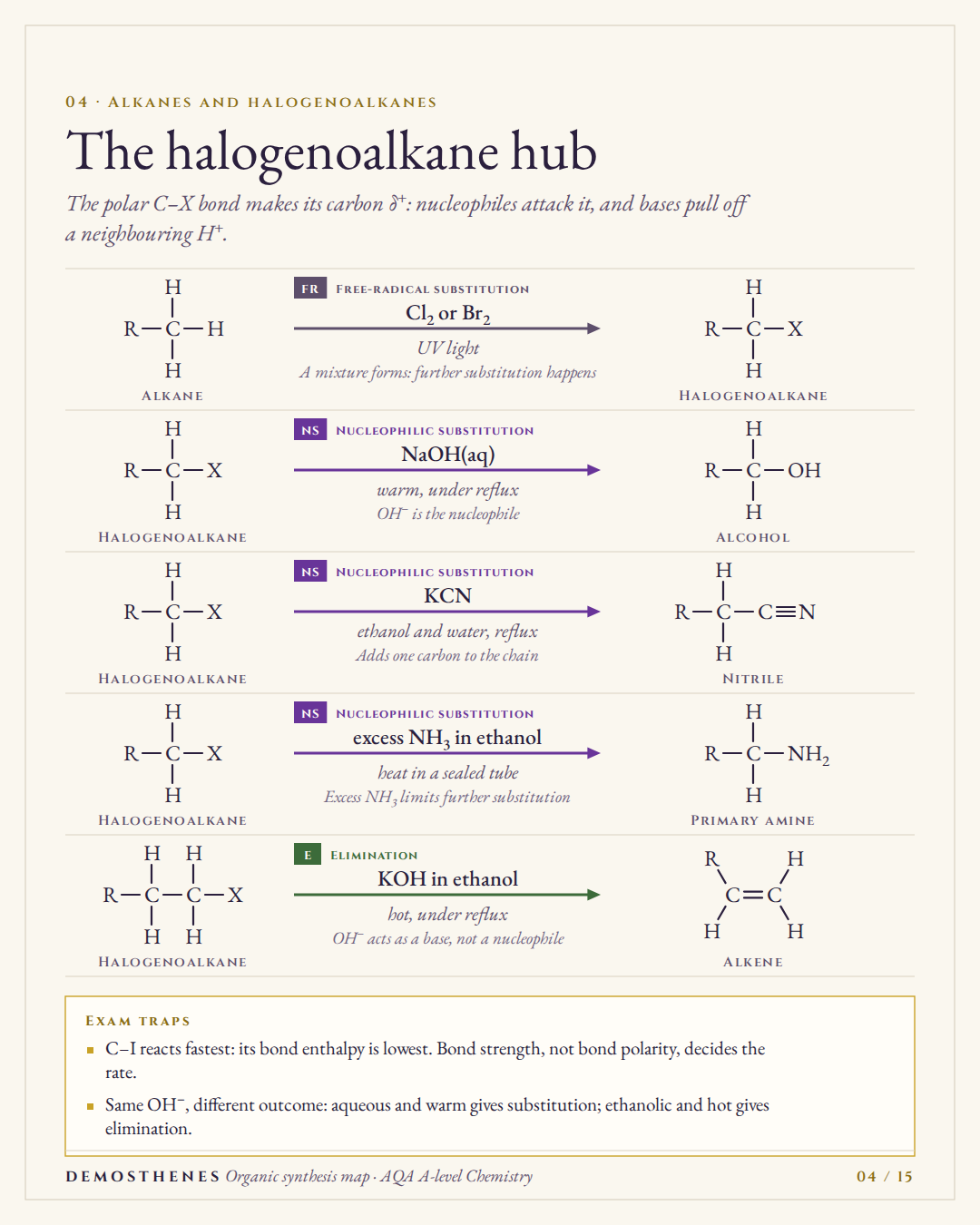
Five reactions: free-radical substitution of an alkane; nucleophilic substitution of a halogenoalkane by hydroxide, cyanide and ammonia; elimination by hot ethanolic KOH.
04 · Alkanes and halogenoalkanes The halogenoalkane hub The polar C–X bond makes its carbon δ + : nucleophiles attack it, and bases pull off a neighbouring H + . C R H H H C R X H H Alkane Halogenoalkane FR Free-radical substitution Cl 2 or Br 2 UV light A mixture forms: further substitution happens C R X H H C R OH H H Halogenoalkane Alcohol NS Nucleophilic substitution NaOH(aq) warm, under reflux OH − is the nucleophile C R X H H R C H H C N Halogenoalkane Nitrile NS Nucleophilic substitution KCN ethanol and water, reflux Adds one carbon to the chain C R X H H C R NH 2 H H Halogenoalkane Primary amine NS Nucleophilic substitution excess NH 3 in ethanol heat in a sealed tube Excess NH 3 limits further substitution R C H H C H H X C C R H H H Halogenoalkane Alkene E Elimination KOH in ethanol hot, under reflux OH − acts as a base, not a nucleophile Exam traps C–I reacts fastest: its bond enthalpy is lowest. Bond strength, not bond polarity, decides the rate. Same OH − , different outcome: aqueous and warm gives substitution; ethanolic and hot gives elimination. DEMOSTHENES Organic synthesis map · AQA A-level Chemistry 04 / 15
04 The halogenoalkane hubPNG
Adding across C=C
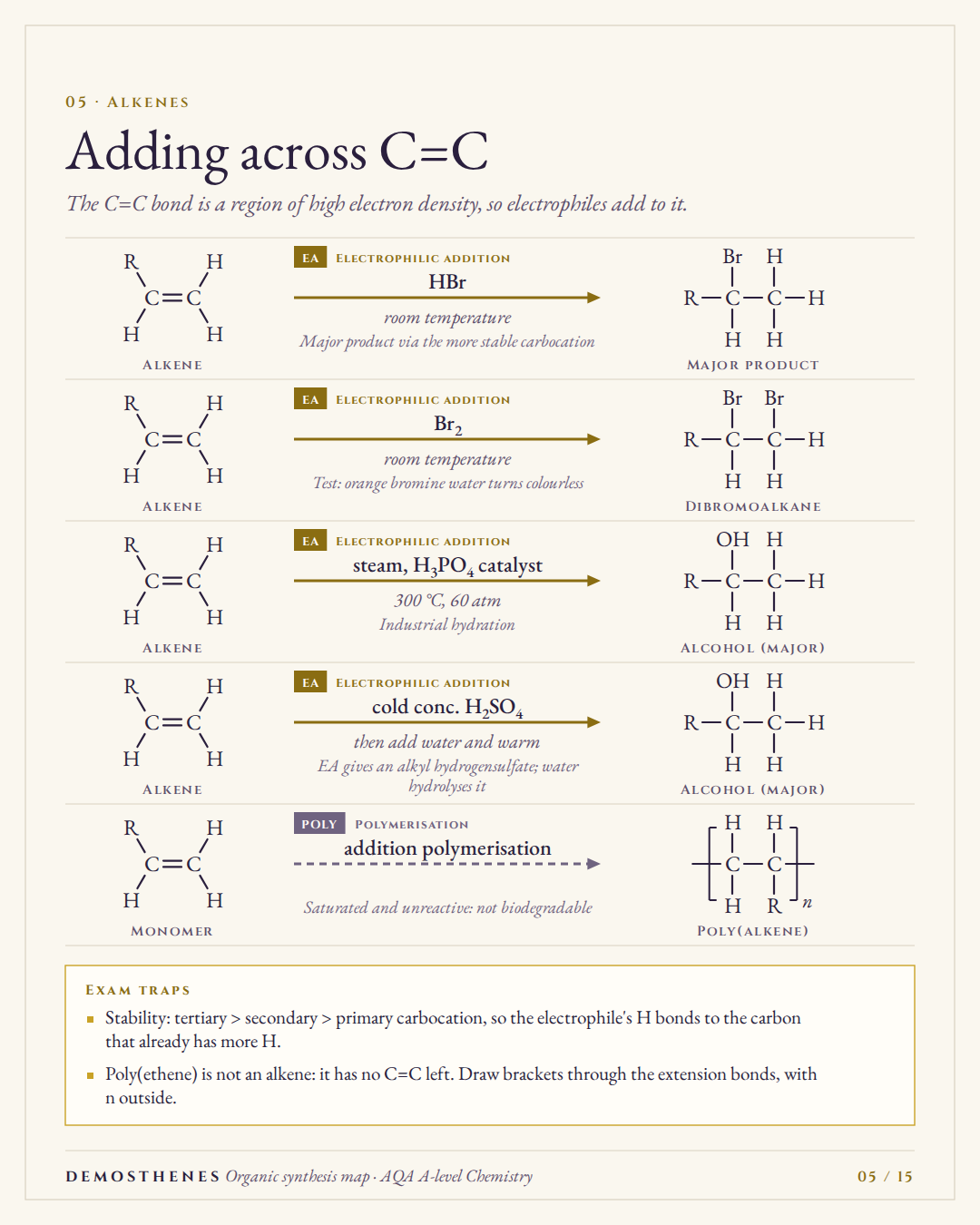
Five reactions of alkenes: electrophilic addition of HBr, Br2, steam and sulfuric acid; addition polymerisation.
05 · Alkenes Adding across C=C The C=C bond is a region of high electron density, so electrophiles add to it. C C R H H H R C Br H C H H H Alkene Major product EA Electrophilic addition HBr room temperature Major product via the more stable carbocation C C R H H H C C R Br H Br H H Alkene Dibromoalkane EA Electrophilic addition Br 2 room temperature Test: orange bromine water turns colourless C C R H H H R C OH H C H H H Alkene Alcohol (major) EA Electrophilic addition steam, H 3 PO 4 catalyst 300 °C, 60 atm Industrial hydration C C R H H H R C OH H C H H H Alkene Alcohol (major) EA Electrophilic addition cold conc. H 2 SO 4 then add water and warm EA gives an alkyl hydrogensulfate; water hydrolyses it C C R H H H C C H H H R n Monomer Poly(alkene) POLY Polymerisation addition polymerisation Saturated and unreactive: not biodegradable Exam traps Stability: tertiary > secondary > primary carbocation, so the electrophile's H bonds to the carbon that already has more H. Poly(ethene) is not an alkene: it has no C=C left. Draw brackets through the extension bonds, with n outside. DEMOSTHENES Organic synthesis map · AQA A-level Chemistry 05 / 15
05 Adding across C=CPNG
Making and oxidising alcohols
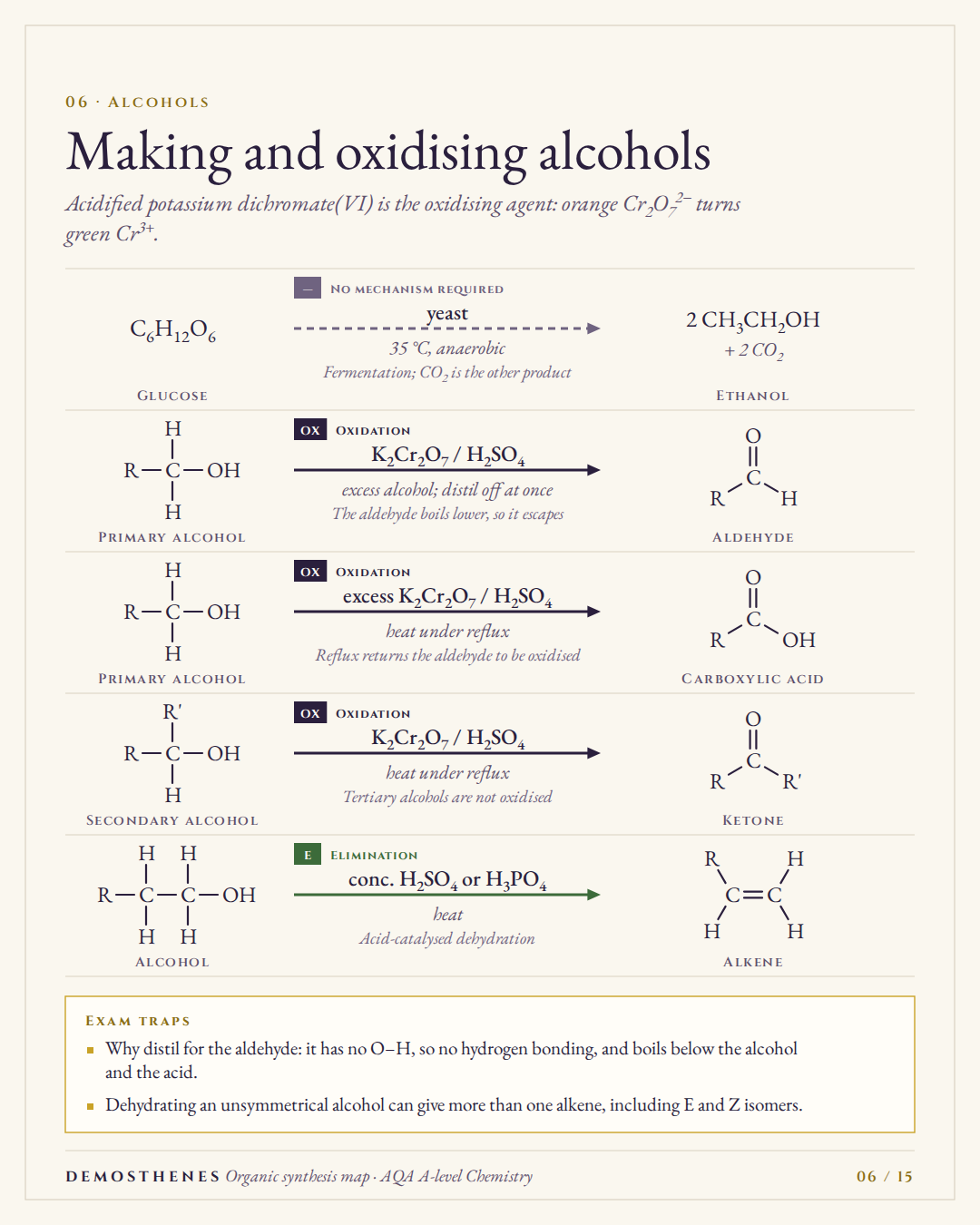
Fermentation of glucose; oxidation of primary alcohols to aldehydes and carboxylic acids and of secondary alcohols to ketones; dehydration to alkenes.
06 · Alcohols Making and oxidising alcohols Acidified potassium dichromate(VI) is the oxidising agent: orange Cr 2 O 7 2− turns green Cr 3+ . C 6 H 12 O 6 2 CH 3 CH 2 OH + 2 CO 2 Glucose Ethanol — No mechanism required yeast 35 °C, anaerobic Fermentation; CO 2 is the other product C R OH H H C O R H Primary alcohol Aldehyde OX Oxidation K 2 Cr 2 O 7 / H 2 SO 4 excess alcohol; distil off at once The aldehyde boils lower, so it escapes C R OH H H C O R OH Primary alcohol Carboxylic acid OX Oxidation excess K 2 Cr 2 O 7 / H 2 SO 4 heat under reflux Reflux returns the aldehyde to be oxidised C R OH R' H C O R R' Secondary alcohol Ketone OX Oxidation K 2 Cr 2 O 7 / H 2 SO 4 heat under reflux Tertiary alcohols are not oxidised R C H H C H H OH C C R H H H Alcohol Alkene E Elimination conc. H 2 SO 4 or H 3 PO 4 heat Acid-catalysed dehydration Exam traps Why distil for the aldehyde: it has no O–H, so no hydrogen bonding, and boils below the alcohol and the acid. Dehydrating an unsymmetrical alcohol can give more than one alkene, including E and Z isomers. DEMOSTHENES Organic synthesis map · AQA A-level Chemistry 06 / 15
06 Making and oxidising alcoholsPNG
The carbonyl group
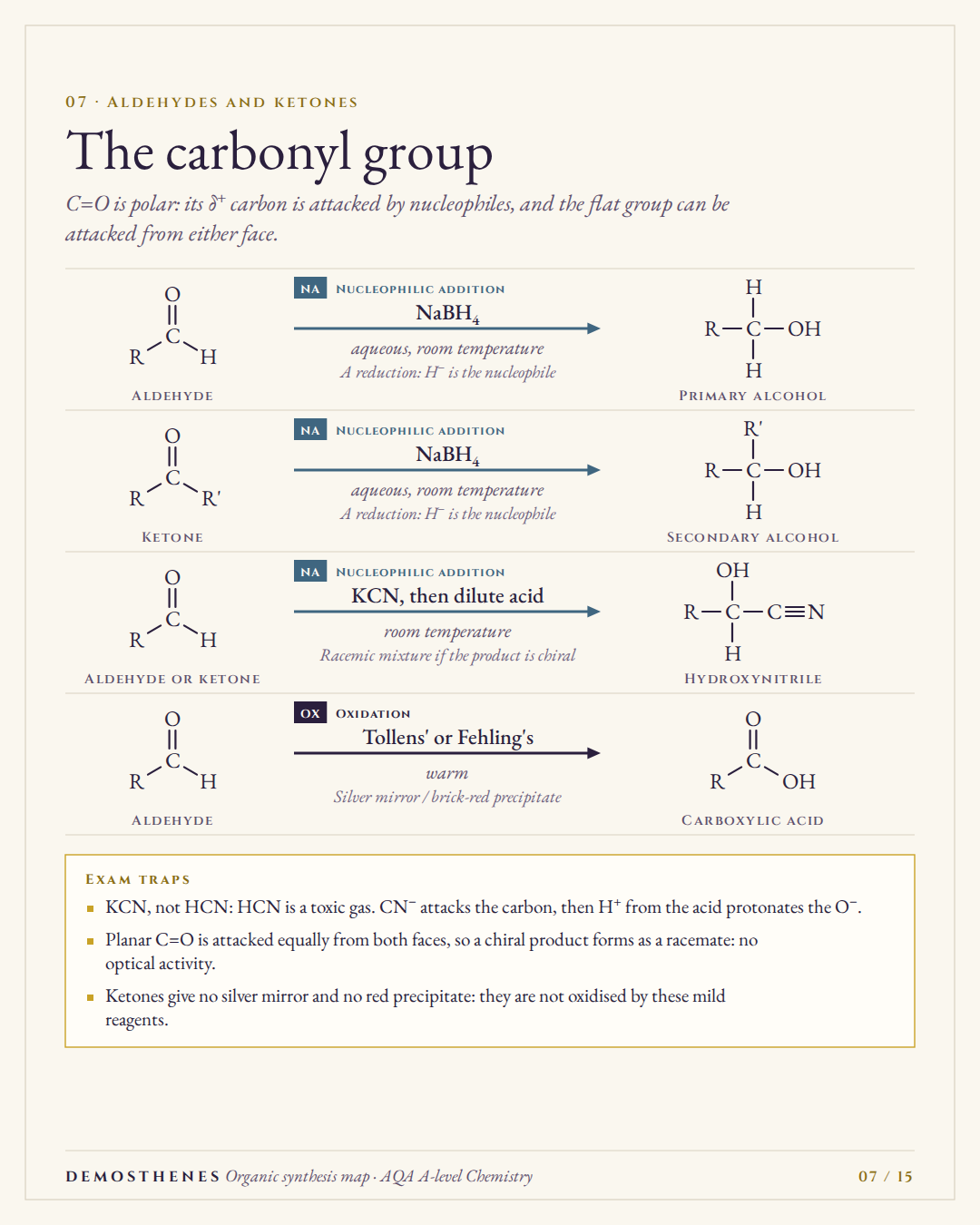
Reduction of aldehydes and ketones by NaBH4; nucleophilic addition of cyanide to give hydroxynitriles; oxidation of aldehydes by Tollens' and Fehling's.
07 · Aldehydes and ketones The carbonyl group C=O is polar: its δ + carbon is attacked by nucleophiles, and the flat group can be attacked from either face. C O R H C R OH H H Aldehyde Primary alcohol NA Nucleophilic addition NaBH 4 aqueous, room temperature A reduction: H − is the nucleophile C O R R' C R OH R' H Ketone Secondary alcohol NA Nucleophilic addition NaBH 4 aqueous, room temperature A reduction: H − is the nucleophile C O R H C R OH H C N Aldehyde or ketone Hydroxynitrile NA Nucleophilic addition KCN, then dilute acid room temperature Racemic mixture if the product is chiral C O R H C O R OH Aldehyde Carboxylic acid OX Oxidation Tollens' or Fehling's warm Silver mirror / brick-red precipitate Exam traps KCN, not HCN: HCN is a toxic gas. CN − attacks the carbon, then H + from the acid protonates the O − . Planar C=O is attacked equally from both faces, so a chiral product forms as a racemate: no optical activity. Ketones give no silver mirror and no red precipitate: they are not oxidised by these mild reagents. DEMOSTHENES Organic synthesis map · AQA A-level Chemistry 07 / 15
07 The carbonyl groupPNG
Acids, esters and fats
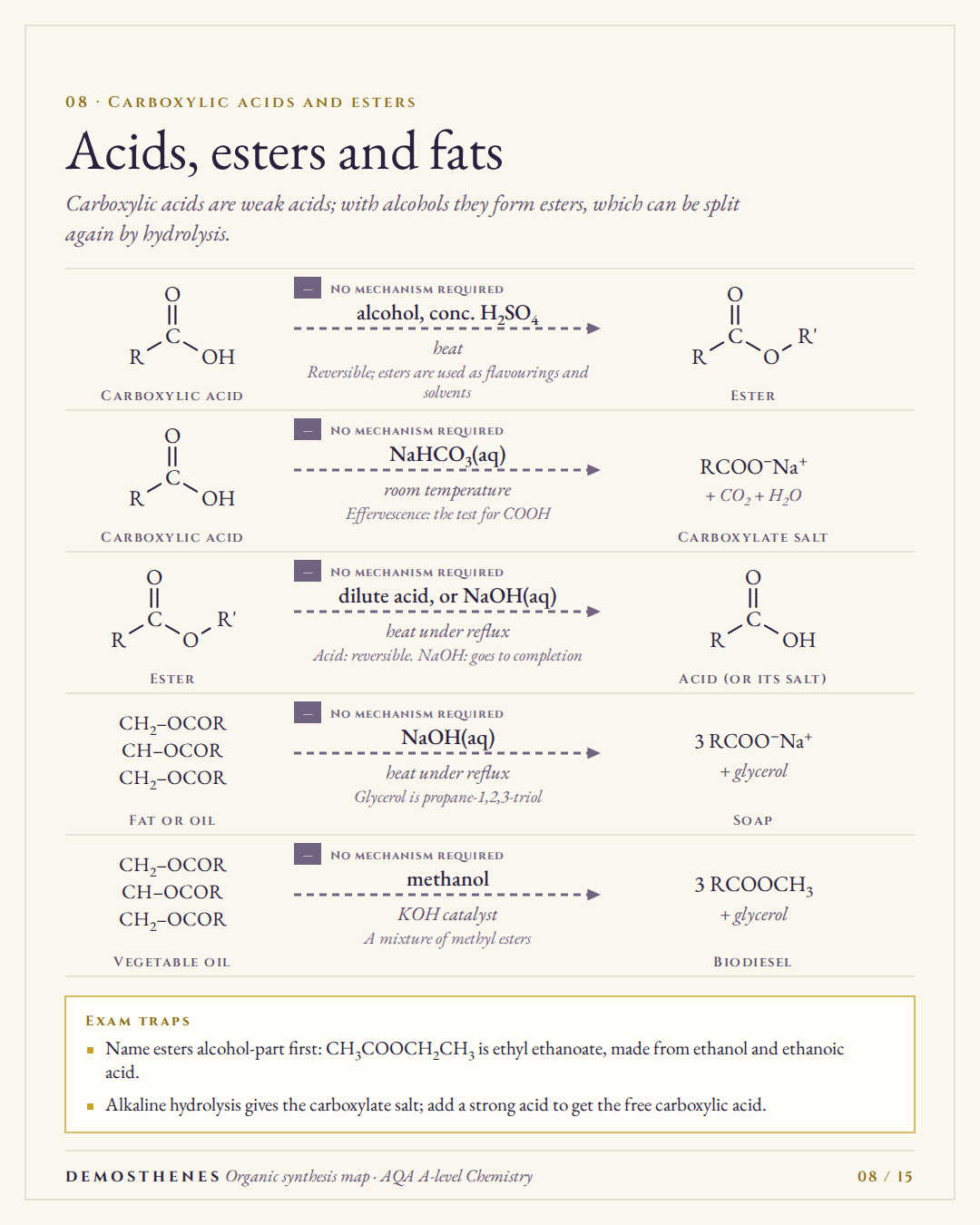
Esterification; the reaction with hydrogencarbonate; acid and alkaline hydrolysis of esters; saponification of fats; biodiesel.
08 · Carboxylic acids and esters Acids, esters and fats Carboxylic acids are weak acids; with alcohols they form esters, which can be split again by hydrolysis. C O R OH C O R O R' Carboxylic acid Ester — No mechanism required alcohol, conc. H 2 SO 4 heat Reversible; esters are used as flavourings and solvents C O R OH RCOO − Na + + CO 2 + H 2 O Carboxylic acid Carboxylate salt — No mechanism required NaHCO 3 (aq) room temperature Effervescence: the test for COOH C O R O R' C O R OH Ester Acid (or its salt) — No mechanism required dilute acid, or NaOH(aq) heat under reflux Acid: reversible. NaOH: goes to completion CH 2 –OCOR CH–OCOR CH 2 –OCOR 3 RCOO − Na + + glycerol Fat or oil Soap — No mechanism required NaOH(aq) heat under reflux Glycerol is propane-1,2,3-triol CH 2 –OCOR CH–OCOR CH 2 –OCOR 3 RCOOCH 3 + glycerol Vegetable oil Biodiesel — No mechanism required methanol KOH catalyst A mixture of methyl esters Exam traps Name esters alcohol-part first: CH 3 COOCH 2 CH 3 is ethyl ethanoate, made from ethanol and ethanoic acid. Alkaline hydrolysis gives the carboxylate salt; add a strong acid to get the free carboxylic acid. DEMOSTHENES Organic synthesis map · AQA A-level Chemistry 08 / 15
08 Acids, esters and fatsPNG
Acylation
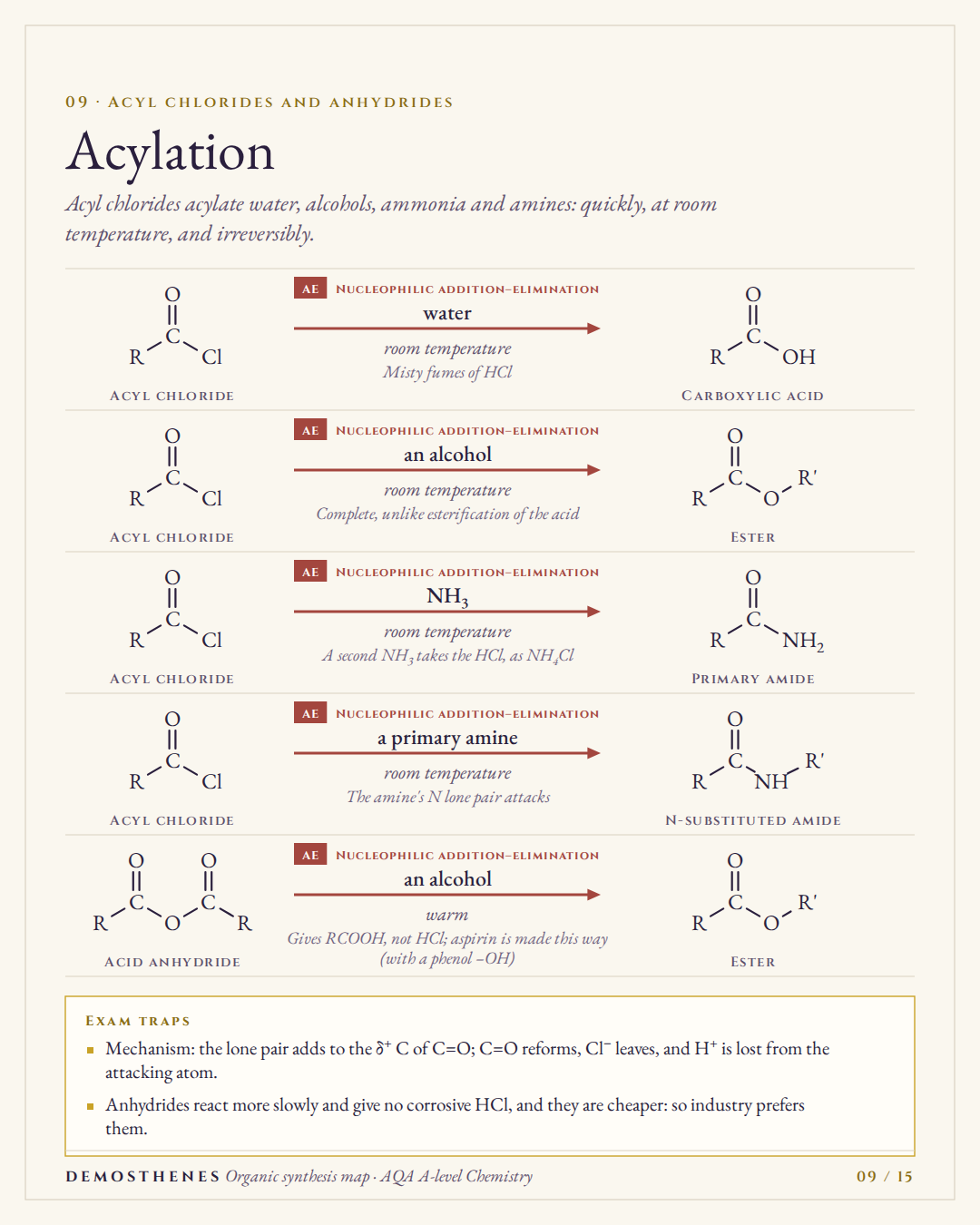
Nucleophilic addition–elimination of acyl chlorides with water, alcohols, ammonia and primary amines; an acid anhydride with an alcohol.
09 · Acyl chlorides and anhydrides Acylation Acyl chlorides acylate water, alcohols, ammonia and amines: quickly, at room temperature, and irreversibly. C O R Cl C O R OH Acyl chloride Carboxylic acid AE Nucleophilic addition–elimination water room temperature Misty fumes of HCl C O R Cl C O R O R' Acyl chloride Ester AE Nucleophilic addition–elimination an alcohol room temperature Complete, unlike esterification of the acid C O R Cl C O R NH 2 Acyl chloride Primary amide AE Nucleophilic addition–elimination NH 3 room temperature A second NH 3 takes the HCl, as NH 4 Cl C O R Cl C O R NH R' Acyl chloride N-substituted amide AE Nucleophilic addition–elimination a primary amine room temperature The amine's N lone pair attacks C O R O C O R C O R O R' Acid anhydride Ester AE Nucleophilic addition–elimination an alcohol warm Gives RCOOH, not HCl; aspirin is made this way (with a phenol –OH) Exam traps Mechanism: the lone pair adds to the δ + C of C=O; C=O reforms, Cl − leaves, and H + is lost from the attacking atom. Anhydrides react more slowly and give no corrosive HCl, and they are cheaper: so industry prefers them. DEMOSTHENES Organic synthesis map · AQA A-level Chemistry 09 / 15
09 AcylationPNG
Nitrogen in, nitrogen on
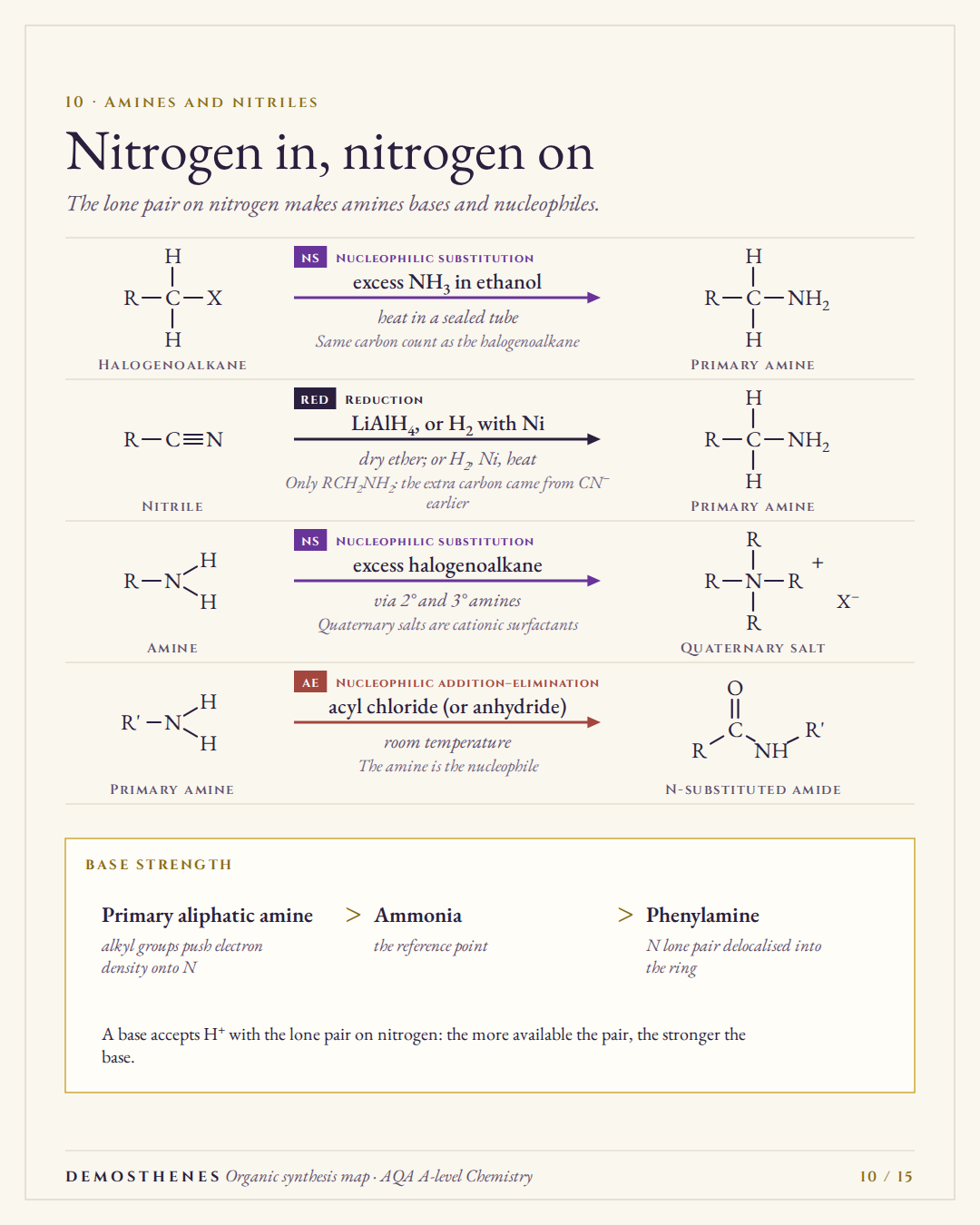
Making primary amines from halogenoalkanes and from nitriles; further substitution to quaternary ammonium salts; acylation of amines; the order of base strength.
10 · Amines and nitriles Nitrogen in, nitrogen on The lone pair on nitrogen makes amines bases and nucleophiles. C R X H H C R NH 2 H H Halogenoalkane Primary amine NS Nucleophilic substitution excess NH 3 in ethanol heat in a sealed tube Same carbon count as the halogenoalkane R C N C R NH 2 H H Nitrile Primary amine RED Reduction LiAlH 4 , or H 2 with Ni dry ether; or H 2 , Ni, heat Only RCH 2 NH 2 : the extra carbon came from CN − earlier R N H H N R R R R + X − Amine Quaternary salt NS Nucleophilic substitution excess halogenoalkane via 2° and 3° amines Quaternary salts are cationic surfactants R' N H H C O R NH R' Primary amine N-substituted amide AE Nucleophilic addition–elimination acyl chloride (or anhydride) room temperature The amine is the nucleophile BASE STRENGTH Primary aliphatic amine alkyl groups push electron density onto N > Ammonia the reference point > Phenylamine N lone pair delocalised into the ring A base accepts H + with the lone pair on nitrogen: the more available the pair, the stronger the base. DEMOSTHENES Organic synthesis map · AQA A-level Chemistry 10 / 15
10 Nitrogen in, nitrogen onPNG
Keeping the ring
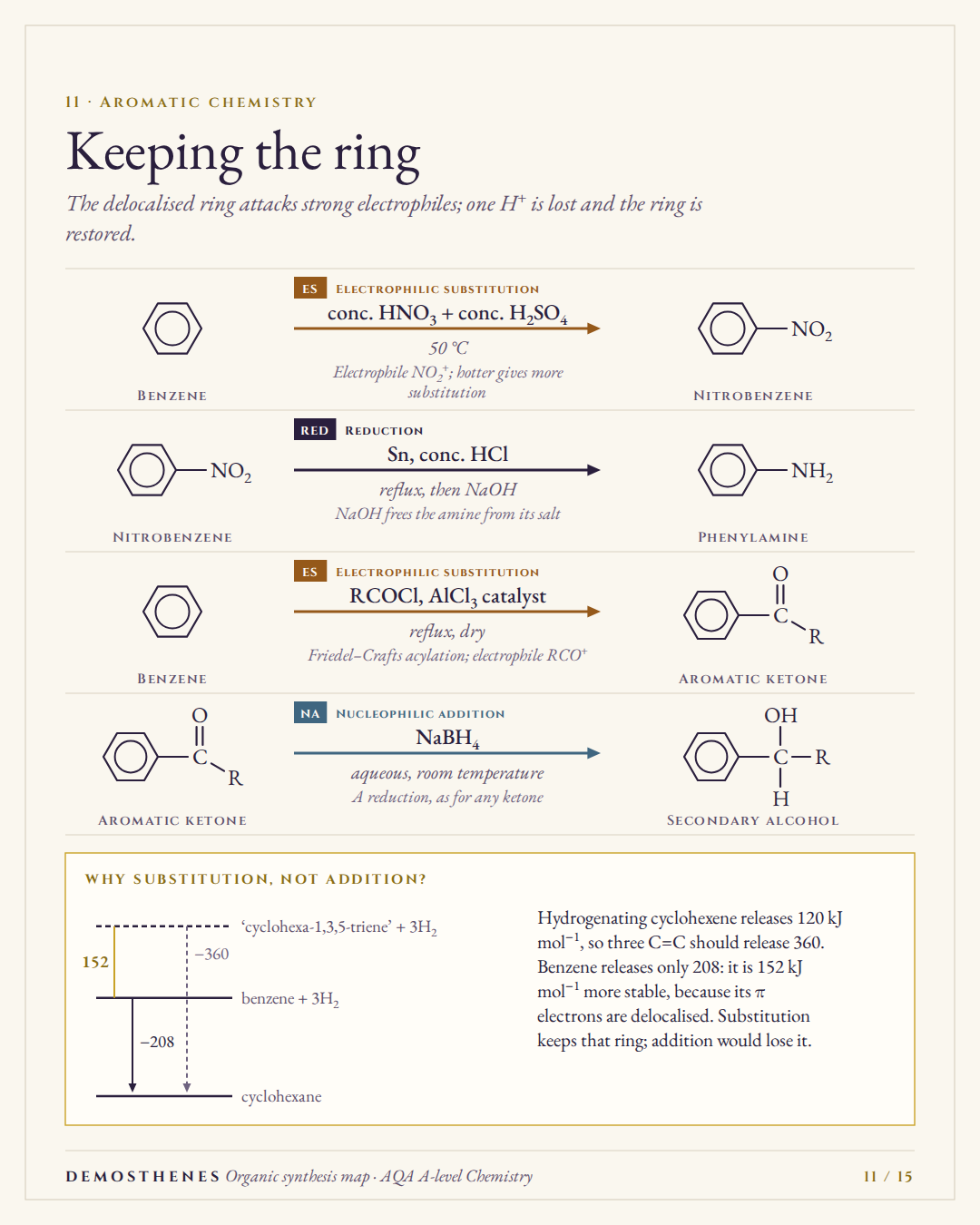
Nitration of benzene and reduction to phenylamine; Friedel–Crafts acylation and reduction of the ketone; the enthalpy evidence for delocalisation.
11 · Aromatic chemistry Keeping the ring The delocalised ring attacks strong electrophiles; one H + is lost and the ring is restored. NO 2 Benzene Nitrobenzene ES Electrophilic substitution conc. HNO 3 + conc. H 2 SO 4 50 °C Electrophile NO 2 + ; hotter gives more substitution NO 2 NH 2 Nitrobenzene Phenylamine RED Reduction Sn, conc. HCl reflux, then NaOH NaOH frees the amine from its salt C O R Benzene Aromatic ketone ES Electrophilic substitution RCOCl, AlCl 3 catalyst reflux, dry Friedel–Crafts acylation; electrophile RCO + C O R C OH H R Aromatic ketone Secondary alcohol NA Nucleophilic addition NaBH 4 aqueous, room temperature A reduction, as for any ketone WHY SUBSTITUTION, NOT ADDITION? ‘cyclohexa-1,3,5-triene’ + 3H 2 benzene + 3H 2 cyclohexane −208 −360 152 Hydrogenating cyclohexene releases 120 kJ mol −1 , so three C=C should release 360. Benzene releases only 208: it is 152 kJ mol −1 more stable, because its π electrons are delocalised. Substitution keeps that ring; addition would lose it. DEMOSTHENES Organic synthesis map · AQA A-level Chemistry 11 / 15
11 Keeping the ringPNG
Addition and condensation polymers
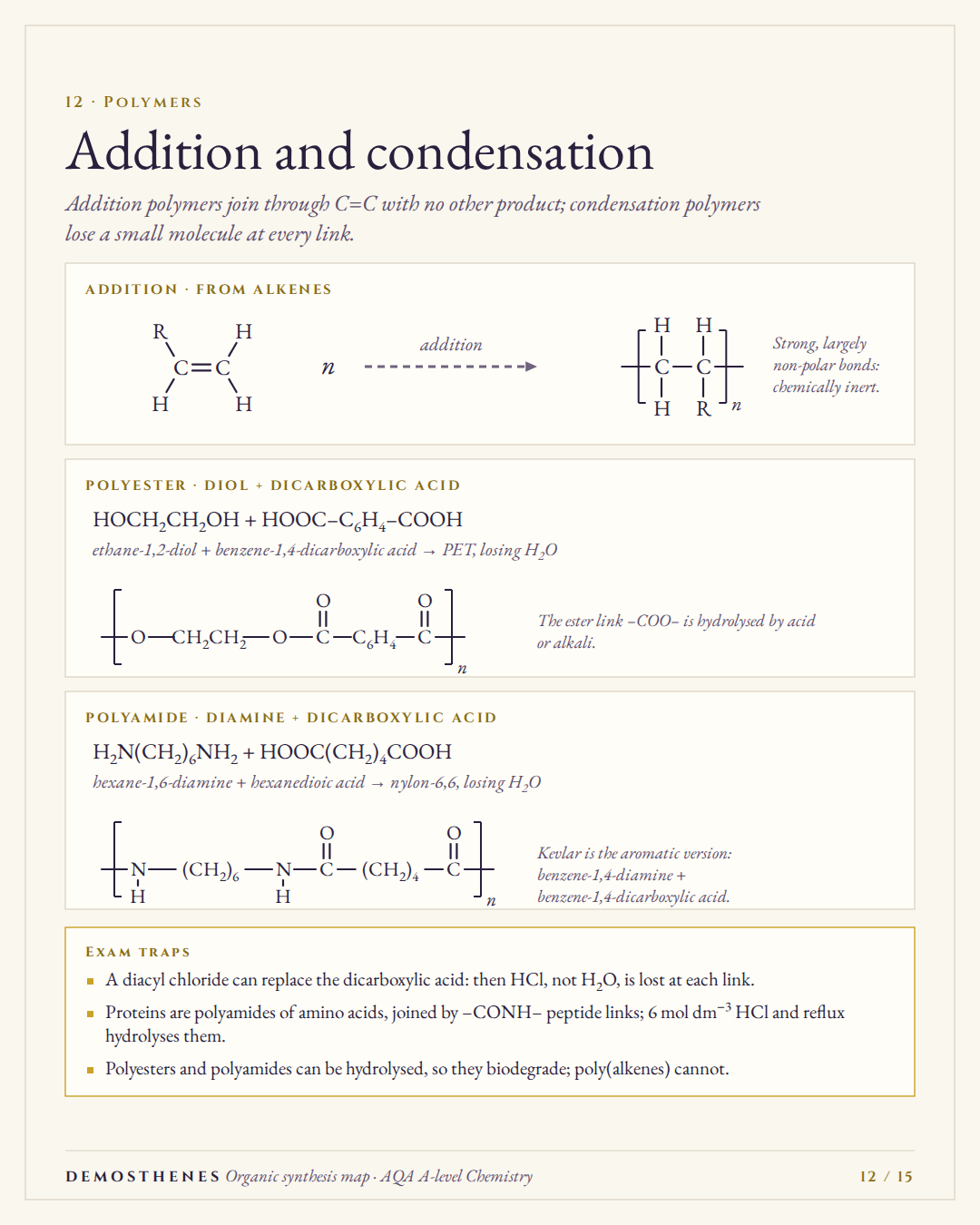
Addition polymerisation of an alkene; polyester PET from ethane-1,2-diol and benzene-1,4-dicarboxylic acid; polyamide nylon-6,6 from hexane-1,6-diamine and hexanedioic acid; Kevlar; proteins.
12 · Polymers Addition and condensation Addition polymers join through C=C with no other product; condensation polymers lose a small molecule at every link. ADDITION · FROM ALKENES C C R H H H n addition C C H H H R n Strong, largely non-polar bonds: chemically inert. POLYESTER · DIOL + DICARBOXYLIC ACID HOCH 2 CH 2 OH + HOOC–C 6 H 4 –COOH ethane-1,2-diol + benzene-1,4-dicarboxylic acid → PET, losing H 2 O O CH 2 CH 2 O C O C 6 H 4 C O n The ester link –COO– is hydrolysed by acid or alkali. POLYAMIDE · DIAMINE + DICARBOXYLIC ACID H 2 N(CH 2 ) 6 NH 2 + HOOC(CH 2 ) 4 COOH hexane-1,6-diamine + hexanedioic acid → nylon-6,6, losing H 2 O N H (CH 2 ) 6 N H C O (CH 2 ) 4 C O n Kevlar is the aromatic version: benzene-1,4-diamine + benzene-1,4-dicarboxylic acid. Exam traps A diacyl chloride can replace the dicarboxylic acid: then HCl, not H 2 O, is lost at each link. Proteins are polyamides of amino acids, joined by –CONH– peptide links; 6 mol dm −3 HCl and reflux hydrolyses them. Polyesters and polyamides can be hydrolysed, so they biodegrade; poly(alkenes) cannot. DEMOSTHENES Organic synthesis map · AQA A-level Chemistry 12 / 15
12 Addition and condensation polymersPNG
Route practice
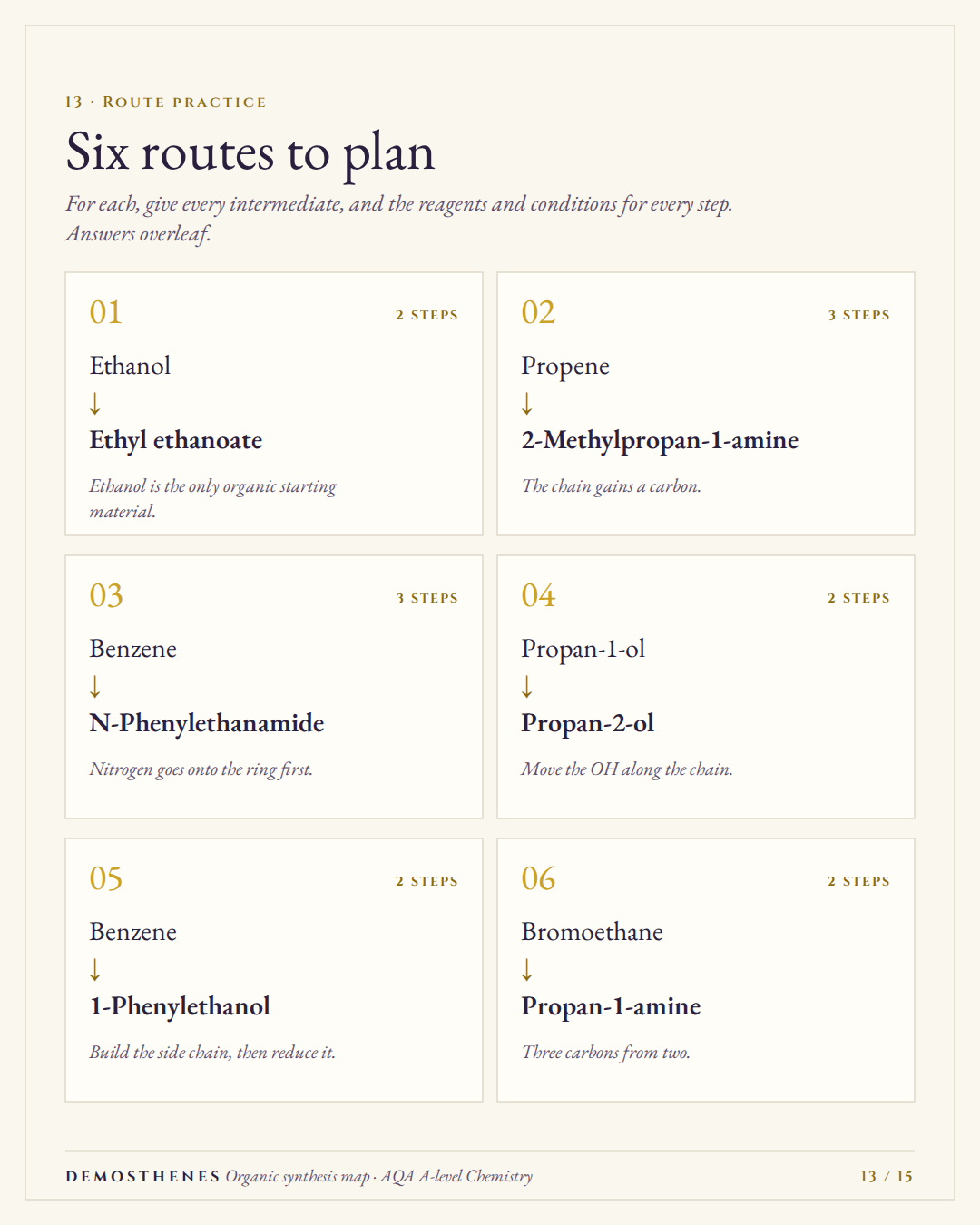
Six synthesis problems: Ethanol to Ethyl ethanoate; Propene to 2-Methylpropan-1-amine; Benzene to N-Phenylethanamide; Propan-1-ol to Propan-2-ol; Benzene to 1-Phenylethanol; Bromoethane to Propan-1-amine.
13 · Route practice Six routes to plan For each, give every intermediate, and the reagents and conditions for every step. Answers overleaf. 01 Ethanol ↓ Ethyl ethanoate 2 STEPS Ethanol is the only organic starting material. 02 Propene ↓ 2-Methylpropan-1-amine 3 STEPS The chain gains a carbon. 03 Benzene ↓ N-Phenylethanamide 3 STEPS Nitrogen goes onto the ring first. 04 Propan-1-ol ↓ Propan-2-ol 2 STEPS Move the OH along the chain. 05 Benzene ↓ 1-Phenylethanol 2 STEPS Build the side chain, then reduce it. 06 Bromoethane ↓ Propan-1-amine 2 STEPS Three carbons from two. DEMOSTHENES Organic synthesis map · AQA A-level Chemistry 13 / 15
13 Route practicePNG
Route answers
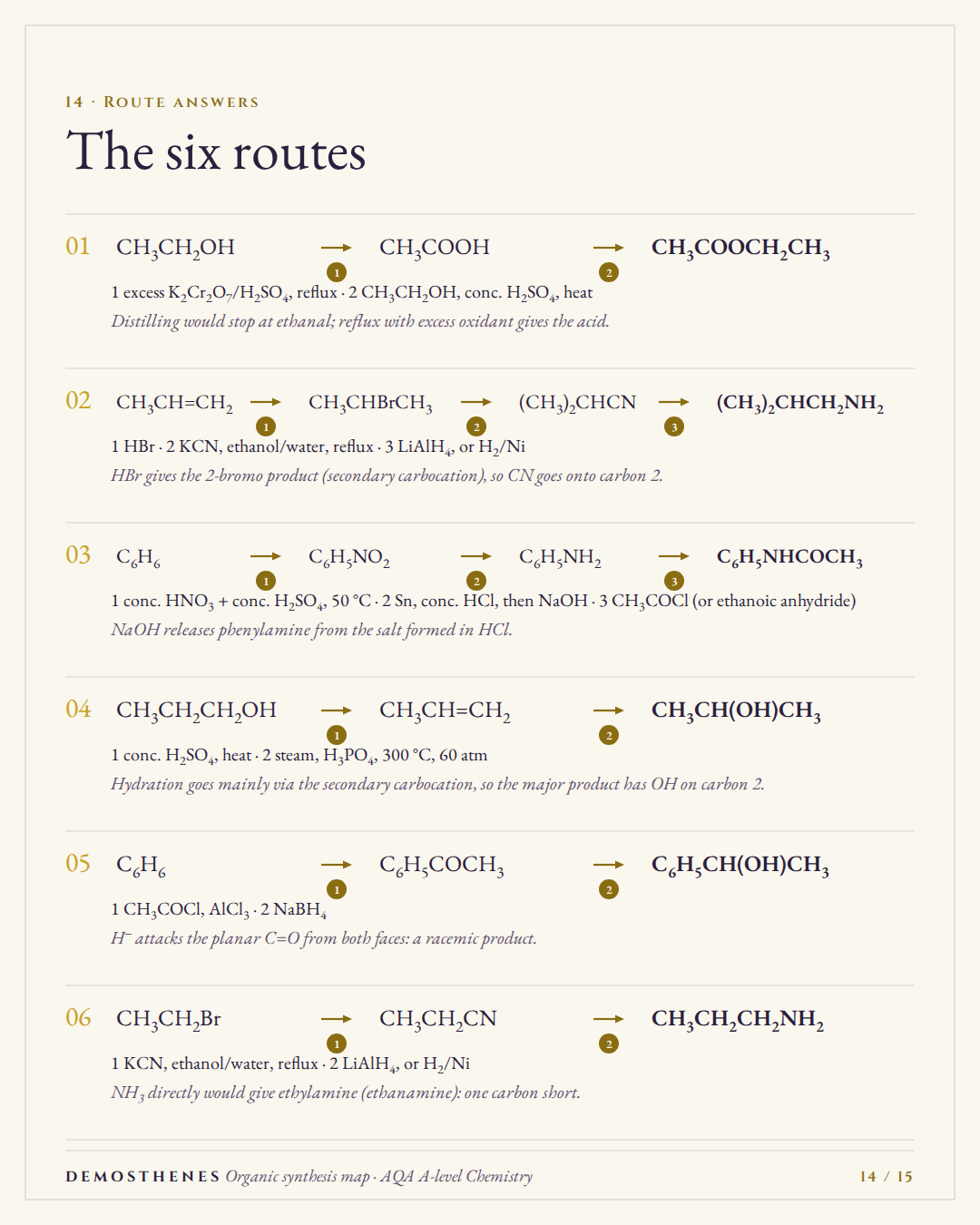
Route 1: CH3CH2OH to CH3COOH to CH3COOCH2CH3, using excess K2Cr2O7/H2SO4, reflux; then CH3CH2OH, conc. H2SO4, heat. Route 2: CH3CH=CH2 to CH3CHBrCH3 to (CH3)2CHCN to (CH3)2CHCH2NH2, using HBr; then KCN, ethanol/water, reflux; then LiAlH4, or H2/Ni. Route 3: C6H6 to C6H5NO2 to C6H5NH2 to C6H5NHCOCH3, using conc. HNO3 + conc. H2SO4, 50 °C; then Sn, conc. HCl, then NaOH; then CH3COCl (or ethanoic anhydride). Route 4: CH3CH2CH2OH to CH3CH=CH2 to CH3CH(OH)CH3, using conc. H2SO4, heat; then steam, H3PO4, 300 °C, 60 atm. Route 5: C6H6 to C6H5COCH3 to C6H5CH(OH)CH3, using CH3COCl, AlCl3; then NaBH4. Route 6: CH3CH2Br to CH3CH2CN to CH3CH2CH2NH2, using KCN, ethanol/water, reflux; then LiAlH4, or H2/Ni.
14 · Route answers The six routes 01 CH 3 CH 2 OH 1 CH 3 COOH 2 CH 3 COOCH 2 CH 3 1 excess K 2 Cr 2 O 7 /H 2 SO 4 , reflux · 2 CH 3 CH 2 OH, conc. H 2 SO 4 , heat Distilling would stop at ethanal; reflux with excess oxidant gives the acid. 02 CH 3 CH=CH 2 1 CH 3 CHBrCH 3 2 (CH 3 ) 2 CHCN 3 (CH 3 ) 2 CHCH 2 NH 2 1 HBr · 2 KCN, ethanol/water, reflux · 3 LiAlH 4 , or H 2 /Ni HBr gives the 2-bromo product (secondary carbocation), so CN goes onto carbon 2. 03 C 6 H 6 1 C 6 H 5 NO 2 2 C 6 H 5 NH 2 3 C 6 H 5 NHCOCH 3 1 conc. HNO 3 + conc. H 2 SO 4 , 50 °C · 2 Sn, conc. HCl, then NaOH · 3 CH 3 COCl (or ethanoic anhydride) NaOH releases phenylamine from the salt formed in HCl. 04 CH 3 CH 2 CH 2 OH 1 CH 3 CH=CH 2 2 CH 3 CH(OH)CH 3 1 conc. H 2 SO 4 , heat · 2 steam, H 3 PO 4 , 300 °C, 60 atm Hydration goes mainly via the secondary carbocation, so the major product has OH on carbon 2. 05 C 6 H 6 1 C 6 H 5 COCH 3 2 C 6 H 5 CH(OH)CH 3 1 CH 3 COCl, AlCl 3 · 2 NaBH 4 H − attacks the planar C=O from both faces: a racemic product. 06 CH 3 CH 2 Br 1 CH 3 CH 2 CN 2 CH 3 CH 2 CH 2 NH 2 1 KCN, ethanol/water, reflux · 2 LiAlH 4 , or H 2 /Ni NH 3 directly would give ethylamine (ethanamine): one carbon short. DEMOSTHENES Organic synthesis map · AQA A-level Chemistry 14 / 15
14 Route answersPNG
Now practise it
Demosthenes: A-level revision for Maths, Further Maths, Biology, Chemistry and Physics, with exam-style questions marked by AI against the mark scheme, and timed papers.
NOW PRACTISE IT A map is learned by using it. Demosthenes is an A-level revision app for Maths, Further Maths, Biology, Chemistry and Physics. Exam-style questions across the course, optional AI marking against each question's mark scheme, and timed papers. The full AQA Chemistry notes are free to read. DEMOSTHENES DEMOSTHENES Organic synthesis map · AQA A-level Chemistry 15 / 15
15 Now practise itPNG
Learn it by using it
Practise organic synthesis, and every other topic, with exam-style questions marked against the mark scheme.
 Per disputationem veritatem quaerimus